As we wrote in an article on Xbox Wire, “You’ll probably die and have to restart a dungeon at some point. This is the developer’s fault, not yours.” The full article comes with some tips and tricks on how to get your kingdom on track and make up for our mistakes!
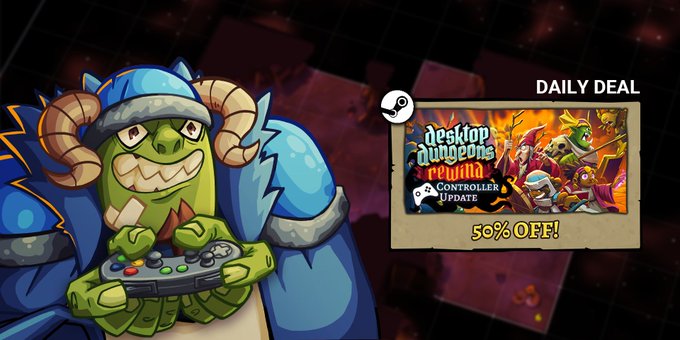
Our game, Desktop Dungeons: Rewind, is 50% off as a Steam Daily Deal today! This ties in to our Controller Update. We’ve been hard at work bringing Controller support to Desktop Dungeons: Rewind. It took quite a bit of iteration to come up with a strong, intuitive control scheme that ultimately allows players to work far more quickly than they would with a virtual mouse style implementation. It’s ready for a variety of controllers including the Steam Deck.
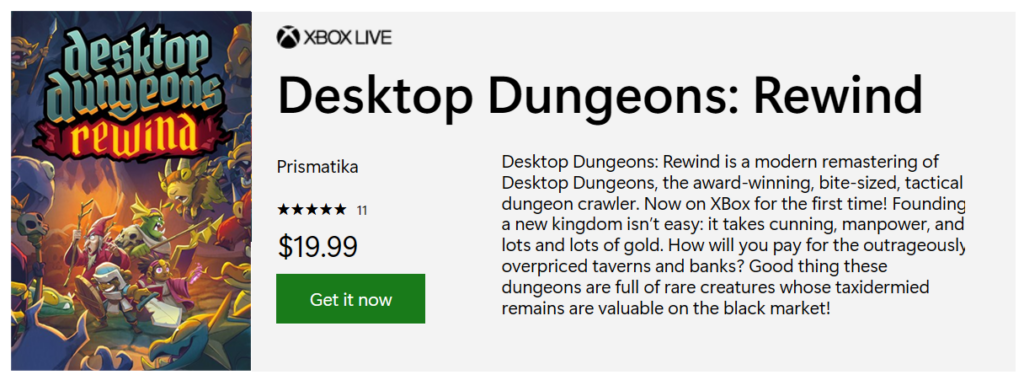
Desktop Dungeons: Rewind will be available on Steam and Humble Games from the 18th of April! We’re incredibly excited to bring this remastered and rebalanced version of the game to you all. Please wishlist on Steam, after which you can give the game a try by playing the Daily Demo right now!
The Desktop Dungeons: Rewind Daily Demo is now live on Steam, allowing you to play a brand new procedurally generated challenge each day! You’ll be able to catch glimpses of a lot of the content in the full game, if you keep playing long enough. If you find the Daily Dungeons fun, consider wishlisting Desktop Dungeons: Rewind while you’re at it to be notified as soon as the updated game releases!
Ever since we added the Daily Dungeon system to Desktop Dungeons in 2015, we’ve toyed with the idea of making a stand-alone version of the dailies as a sort of demo/intro to the game. With Desktop Dungeons: Rewind, we’ve done exactly that! AND it’ll be available on the 25th, you should wishlist right now!
Now that we’re working on Desktop Dungeons: Rewind we have an opportunity to re-visit some of the old decisions that were made during development. A decade ago, we felt we had things to say about gender representation in games. Not only have our views matured, but they’re sadly more pertinent than ever (that’s right, QCF says Trans Rights). This article by Jon Keevy (writer on Rewind) goes into detail about our most recent decisions to broaden gender representation in the game:
When you play a game, do you see yourself in the story? Obviously you haven’t gone toe to toe with a dragon in your real life (probably), or had to scavenge antibiotics while hiding from zombies. But you can see bravery, determination, cunning, and whatever spectrum of human emotion the developers have explored. Emotions that resonate with your inner life.
But what about your outer life? Do you literally see yourself in the story? In the characters? If you’re white and male then you share that with a majority of game characters, and an even higher proportion of the protagonists. We don’t have to litigate the gender and race imbalance in games; it’s there. It’s the product of innumerable decisions by teams and individuals. Or rather one decision made over and over again: to go with the perceived default.
When we first made Desktop Dungeons, we made that same decision. This article is about how we unmade it and why.
The earliest iteration of Desktop Dungeons seen in public was the freeware version. The core mechanics of DD were in place, including many of the adventurer class and race combinations. It was at Indie-cade where we were asked a very obvious question: “Why are all the characters male?”
This question wasn’t a surprise. The team had realised the near total lack of female representation in the prototype up to that point, and was already working to correct it. But the reason it got asked in the first place is because we had made that same decision: we went with the default. Even with progressive politics and good intentions the default snuck in via our unconscious biases. And this didn’t just apply to gender. Our characters were overwhelmingly white.
But because we’d recognised what we’d done, we were able to fix it and turn Desktop Dungeons into an ideal example of representation done right. Except it wasn’t that simple. It never is. The solution to bad representation isn’t good representation, it’s reforming the process and systems that produced the bad representation. It requires not only a philosophical but also a technical approach, with all the provisos around time and capacity that comes with it. This is true even though we had decided that character gender should have nothing to do with how Desktop Dungeons works. It is devoid of mechanical impact. The same can’t be said of race. ‘Race’ is a messy term when it comes to fantasy, humans being a race unto themselves and non-humans also being races. We changed our terminology from ‘Race’ to ‘Kin’ – a quick fix to the confusion, but not to the lack of diverse human representation.
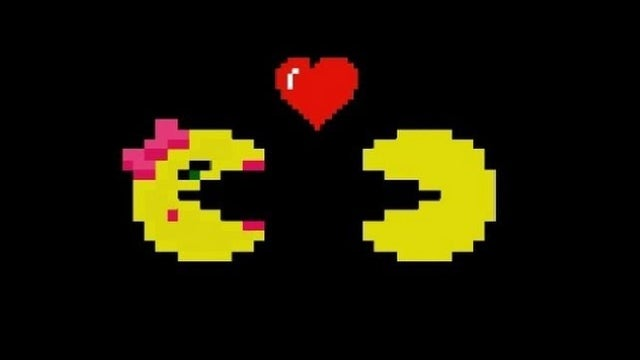
The solution we attempted for the full release of Desktop Dungeons was to create a female version of every playable class/kin combo. Equality! Players would get a random gender for each dungeon run. The technical problem was that this approach doubled the amount of art to create, increasing the workload to the limits of the team’s capacity. Perhaps this is why the default choices started creeping back in. Female coding in games (in the semiotic and not the programming sense of ‘coding’) can be stunningly basic. It’s best summed up by Ms. Pacman and her pink bow.
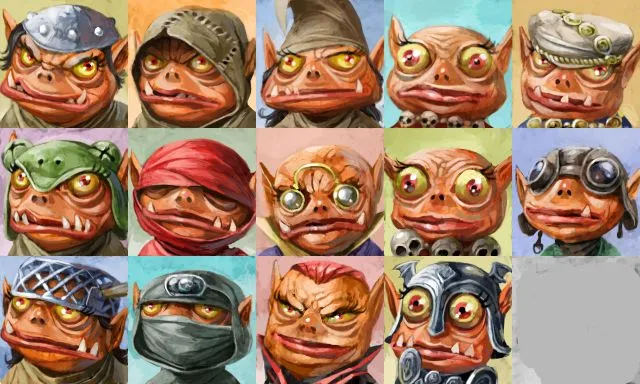
We repeatedly fell into this shorthand for ‘female’. We deliberately and successfully avoided the sexualisation of the female characters but the eyelashes got out of hand.
The end result was a genuine attempt at adding female representation but it fell short of what we wanted to achieve. In fact after release we wrote the forebearer to this article and came to this conclusion:
“If there’s one thing that we hope, it’s that our next game project will be more observant and inclusive from the very beginning, encompassing intersectional representation where possible and showing players that there’s always one more way to represent a complex group of people!”
And here we are. It’s not every team that’s afforded the privilege of trying again. And rarer still to have a second chance at the same game. So, did we make good on our hopes? We started development knowing the goal and knowing why we fell short before. Here’s what we did:
First off we scrapped our binary thinking about gender expression. We need non-binary, agender and androgynous representation! And we tweaked our language around it as well and spoke about male- or female-presenting characters. Secondly we needed the work to be within our capacity. The solution involved dice.
Instead of creating male/female versions of each class/kin combo there would be only one portrait for each. Players had never been able to choose gender before, so that remained unchanged. We went through the list and divided them up into male-presenting, female-presenting, or agender. There was definitely a programmatic way to do these, but we’ll take any excuse to break out some physical dice. We got rolling: 1 & 2 male-presenting, 3 & 4 female-presenting, 5 agender, and 6 reroll. The reroll was to balance out the statistics but we realised it also mapped well to a character choosing a gender expression that may have differed to what they were assigned at their creation. Yup, some Desktop Dungeons characters are canonically trans. No, we’re not revealing who.
This led to a new way of thinking of the class/kin combos. They really became individual characters to us. There’s only one gnome priest and she is feeling too old for this shit. Thinking of them as individuals allowed us to scrap prescriptive thinking for the art direction. These are a random sampling of characters from the world of Desktop Dungeons and the expression of that broke the gender and race coding we’d struggled with originally.
Can everyone see themselves somewhere in Desktop Dungeons? No, not yet. We know that our principles and our ambitions are constrained by unconscious forces even as we try to examine ourselves. They’re constrained by our limited time and capacity, and the choices of what to prioritise. And so we wait with an open mind to hear what our community has to say, what they see that was invisible to us.
Getting an opportunity to learn from our mistakes is a privilege we’re grateful for. An opportunity to develop as creators and as humans. We will keep growing and refusing to choose the default, because everyone deserves to see themselves in the games they play.
Having to deal with a team splitting up and going their own way? Yup: The Desktop Dungeons team stopped being a thing in 2015. We tried to be “QCF” and make more games together, but we couldn’t find a project we all wanted to work on, or even a creative rhythm. Some are still friends, some I haven’t spoken to in years. Most still work in games and a few have gone on to be really successful. It’s a hard thing to realise you probably won’t make anything more with a group of people you saw every day.
Having a child and finding out just how fragile your concentration actually is? Yeah: Not only is it this hugely sobering, bone-deep knowledge that this tiny person is going to depend on your for everything so you’d better get your shit together, it’s also just a straight up fuck you to the idea of how you used to work. Or sleep. I still don’t feel like I can work anywhere near as well or as focused as I used to, and my child is 2 now.
Needing to re-focus to afford renovations and kids and life? Yes. I mean, I know I’m lucky to have something like Desktop Dungeons and I’m grateful for how lucky we got with the game, but it wasn’t paying the bills anymore, I had to stop living in a decaying hovel and I honestly wasn’t sure what the hell I was going to do after the baby arrived. So I hustled, sold a prototype to Humble (thanks John!), did a lot of soul searching and joined Spry Fox. Which wasn’t really a hard decision, I didn’t want to manage a team again at that point and I knew quite a few Foxes already, so becoming one myself and not having to worry about salaries and just dive into code every day and have time to figure out how to be a dad? Very worth it, but also very not what QCF and my career had been so far.
Edit: This isn’t an announcement of me leaving QCF or ending support for Desktop Dungeons – I’ve been at Spry Fox for over a year and a half now and it’s been great! (We just launched Steambirds, which you should play) I’m still maintaining things in my spare time and slowly working on my own projects on the side, apologies if I didn’t communicate that very well.
Still having to support what got you this far? I’m the only person who maintains Desktop Dungeons. The long tail sales are pretty flat, I suspect a smarter studio would have stopped paying revenue shares a while back and just sort of put everything aside. I can’t, I love the game too much and the idea of it still finding players is still rewarding. I’m not sure how to deal with the MacOS 64bit thing though, I’ve already handled numerous iOS and Android headaches and this one might be impossible without a huge update to a new Unity version (at the very least). I check 2 forums, a discord, google alerts and our various email addresses every week, still. Support takes it out of you.
And finally, that feeling of scratching away at a game idea that you know has something cool, but you just can’t find it… Oh how I relate. The thing I sold to Humble, my current side project, Drawkanoid, has existed since 2006 when it was the game that was supposed to let me go indie after a stint working on a PSP game at South Africa’s only console studio. It didn’t, obviously, and I kept working on it between client jobs and it just… Always sucked? But sucked in ways that I felt I could fix!
Drawkanoid was sort of this white whale of a game concept that I’d iterated on in my head a million times. I couldn’t communicate it to anyone else because my thinking about it was so convoluted, we tried to work on it as QCF after Desktop Dungeons shipped, but that proved impossible. Eventually I was at an 8hr game jam with no good ideas and I figured why not try the biggest impact things I’d last written down for Drawkanoid. The first two were the special kind of bad that Drawkanoid is very good at producing, which I was used to, but this time-slowing super-fast ball idea felt good. Okay, it worked at the jam but Drawkanoid ideas never really work out with players, so I was floored when I showed it to John from Humble in a corridor at GDC and he liked it? Enough to offer to pay for it to become more than a prototype?
Drawkanoid is it’s own game now, it’s nearly finished, but I still don’t really trust it because of how it always felt like it wasn’t good enough. It’s won awards and been the second game that’s taken me all over the world, but it still feels like it could be better? I’m very glad it’s a side project, if it had to sustain me and QCF, I would have abandoned it again. But now that the pressure is off of it, I get to sort of play with the thing a little, even though I don’t trust that it’ll do well. I would never, ever have worked on Drawkanoid with my own future on the line.
So I don’t really know how to handle a game idea that won’t leave you alone but won’t surrender its own fun easily. I do know that the pressure to produce and succeed and EARN made everything ten times as hard, being able to put it away until someone else REALLY wanted it was the best thing by far. I’m starting to feel like projects drag you through them despite what you want to do, that you need to find things with that sort of inexorable momentum, that keep coming back even when you stop working on them. Desktop Dungeons was a non-stop version of that, even though it didn’t feel like it at the time, Drawkanoid is a slow pull. I wonder how many other different ways that kind of momentum can exist, but it’s unmistakable once it takes hold.
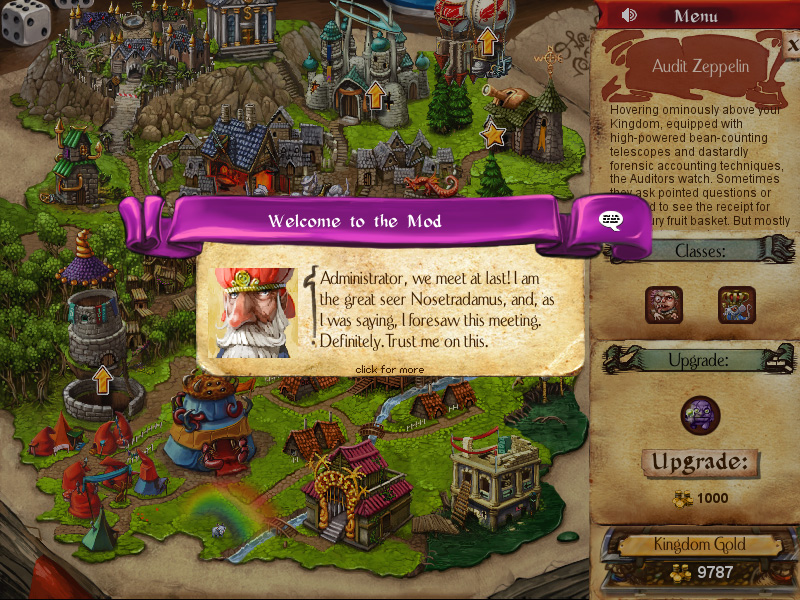
Some of you are far too diligent. Far, far too diligent… We’re getting reports that few puzzle remain unsolved, rainbow borders surround dungeons galore and even Goatpeople are welcome in taverns under your watchful reign(s). This simply will not do! Which is why there’s a dedicated group of incensed Desktop Dungeons fans hard at work on a mod for the game to add new challenges, new classes, new dungeons and new puzzles for you.
The Extreme Edition has just received an update that adds more to the Eastern regions of your Kingdoms, as well as bringing the mod up to the current version of the game (so no more switching to legacy mode via Steam). All told, this update adds:
4 new classes to play, with 6 new class challenges.
More than 25 new items to discover.
11 new dungeons spread out over 2 quests.
8 new ways monsters will mess with you.
And additional secrets that they didn’t tell me about and I haven’t found yet…
Seriously, this mod is an amazing project by loving Desktop Dungeons fans that are doing amazing things and sticking true to the game we loved developing. It’s a complete blast playing new classes and challenges in a game we otherwise know inside out and we hope you’ll enjoy this update as much as we have. The modders have even found ways to add new art to the game, which blows our minds, we didn’t think that was possible.
If you’ve enjoyed Desktop Dungeons and want more of it, download the mod and follow the installation instructions. And please, backup your saves!
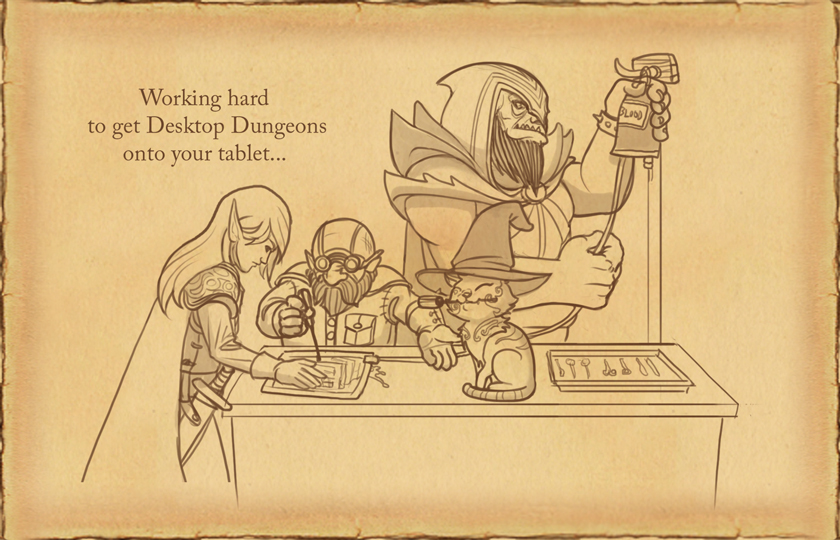
We get a lot of complaints about Desktop Dungeons: It’s too difficult, I can’t stop playing, What’s with the goats, etc. One thing people seem to be glad of is that they’re able to escape the game by moving away from their computers. This upsets us immensely! To rectify this huge oversight, we’re releasing Desktop Dungeons for both Android tablets and iPad on May 28th, 2015. It’ll set you back a mere $10.
We were initially quite worried about getting the game onto Android (there are times that being an African studio really makes indie life difficult) but thanks to our friends at Finji, we’re able to bring the game to Android at the same time as we publish it on iOS. So, Desktop Dungeons is getting a simultaneous release on those two platforms.
We’re sure some people are going to be curious about the $10 price. It’s actually really simple: We don’t think that Desktop Dungeons would work as a F2P game, not without huge changes that we feel would make the game experience worse as a whole. We’re focused on bringing the same game from PC to tablets, trying to rip out and rewire the guts of the gameplay to allow the game to nickel and dime people to death just doesn’t feel good. So, $10 it is. We feel like that’s a good deal for a game with as much replay value as Desktop Dungeons.
The Cloud Sync saving system that grew up over the beta and keeps the game up to date no matter where you play it has been extended to include iOS and Android as well. All your current Kingdoms will be playable on any device that’s online and logged in to DesktopDungeons.net. This was actually a significant amount of work over the last couple of months, but I’m sure we’ll blog about that later; We feel that more developers should offer this kind of portability.
Desktop Dungeons on tablets will contain all of the extra Enhanced Edition content, so you’ll be able to play the Chemist and Rat Monarch right off the bat. Each mobile platform does have different Daily Dungeon seeds and leaderboards though, so you’ll be able to do a maximum of three different dailies if you feel like it. There’s no Goatperson DLC planned for the tablet versions as yet, but if you log in with a DD.net account that has the DLC you’ll be able to play the Goatperson and the triple quests as much as you’d like.
We’re super excited to be releasing Desktop Dungeons on mobile. This has been the number one request that we’ve received since we started working on the game and it’s been a long road to get to this point. Next week it’ll finally be real. See you on the 28th!
Be sure to check out our presskit for more information on the game, screenshots and trailers like the one above.
We’re very happy to announce the Enhanced Edition of Desktop Dungeons. If you’ve been visiting our forums, you might have gathered quite a lot of what this entails, but we thought it was time to actually collect it all in one place and clear up some details:
As you already know, we’ve been working hard to bring Desktop Dungeons to mobile platforms. While we’ve been streamlining the interface and reworking chunks of the game, we’ve also added things, because, well… because we couldn’t really not, there just too many interesting ideas to explore with this game. This has culminated in the expansion that we’ve called Enhanced Edition.
The Enhanced Edition is a free expansion to Desktop Dungeons that adds new classes that create fascinating interactions and quests that push your thinking in how to deal with them. It comes with parts of the streamlined interface changes that make understanding the game a little easier. It has also had a pretty major overhaul as far as optimization goes, but that is distinctly less sexy to talk about, let’s move on. There’s a new building that houses…
Daily Challenges
Your Kingdom is being audited, but in order to check the correct boxes and fill what seems to be an infinite void of incomplete records, you have to recreate lost adventure reports as part of the Daily Expedition Re-enactment Program, or DERP, every day a new DERP. You’ll be able to pit yourself against your friends with this seeded adventure each day. The daily expedition preparation choices also allow you to play with combinations that you might not actually be able to have in the game and select multiple preparations from the same building. These auditors are all about the hypothetical, so it’s time to explore your ideal power combos! Daily expeditions will reset at midnight, GMT.
This seed will be different on each of the mobile platforms, so while you can only play the daily once per day on PC(inc. Mac and Linux) you’ll be able to play a second hypothetical re-enactment on your iPad and then a third on your Android tablet. Each with their own leaderboards.
Let’s talk Mobile
The mobile version is a full one-to-one port of the game with a spiffy new interface for touch devices. All of your cloud saved kingdoms (built in if you log into your Desktop Dungeons account) will synchronize across the various platforms. So you won’t even lose your kingdom progress when you leave your PC and whip out your iPad for a quick run of Ick Swamp whilst on the bus.
When? WHEN?!
The Enhanced Edition will roll out on Steam, GOG and Humble on the 20th of April, with the mobile release following soon after that.